Tool
calivue
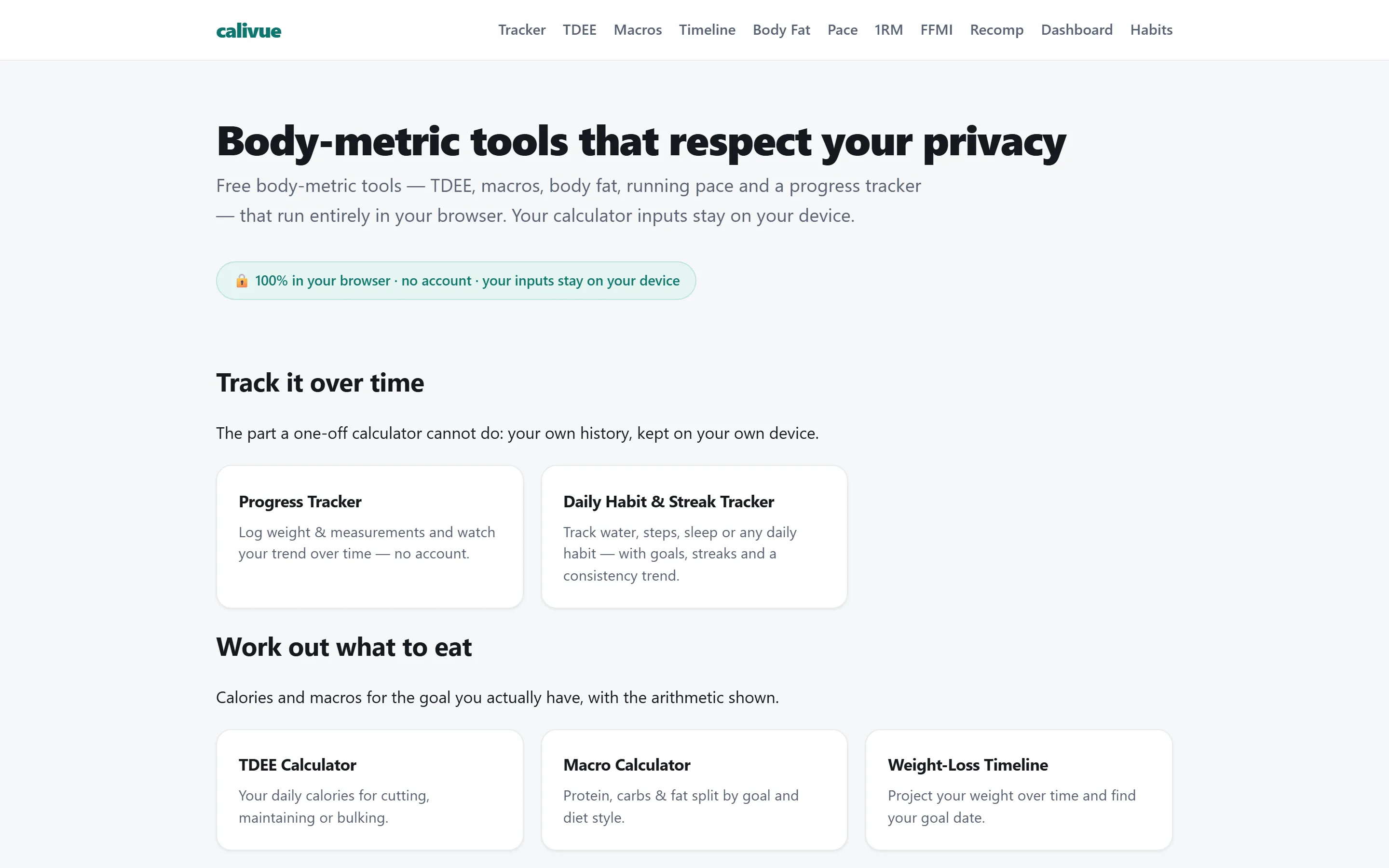
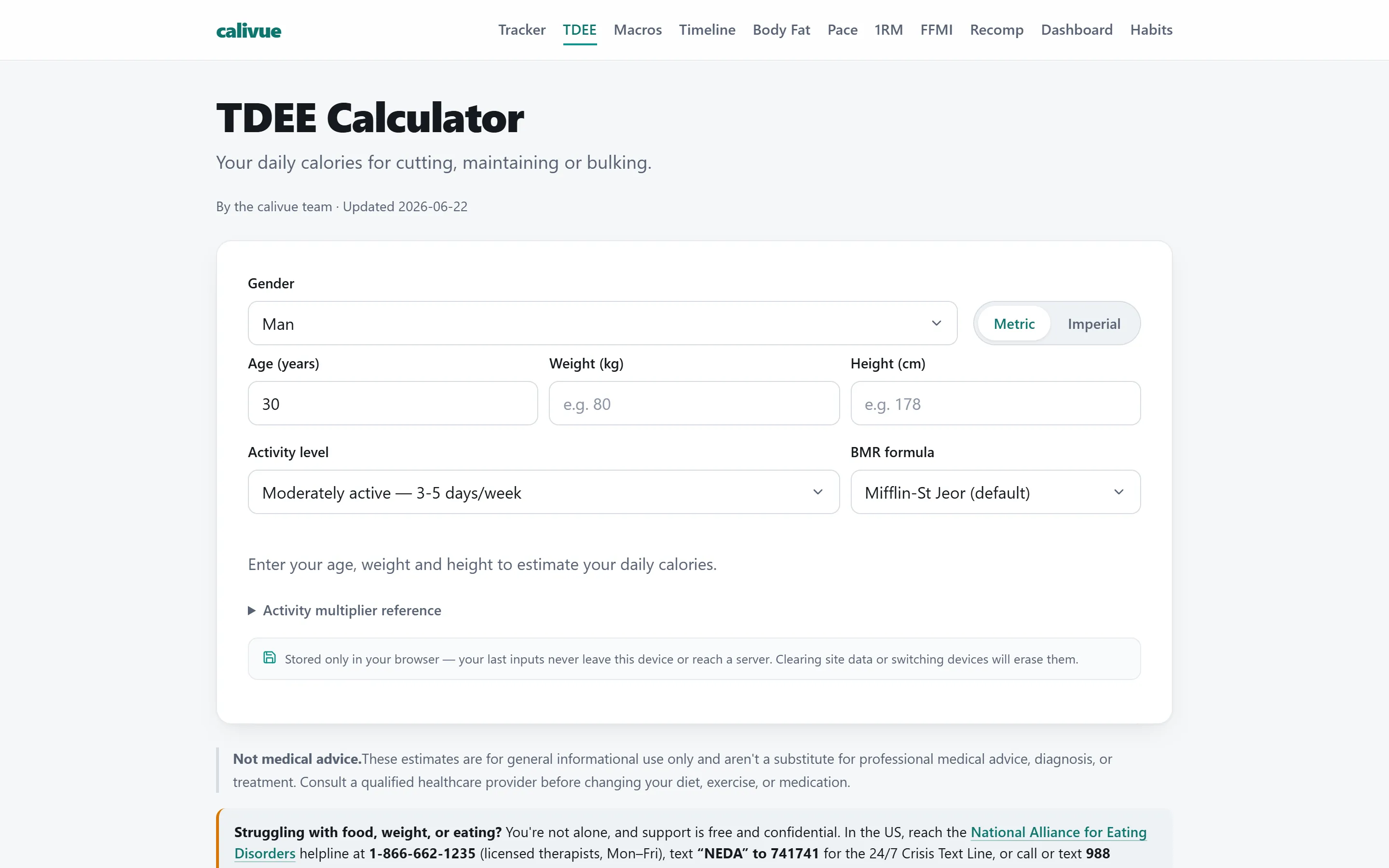
Fast, private, visual body-metric tools: daily energy, macros, body fat, strength and pace, with a habit tracker and progress dashboard, everything running in the browser to a hard performance and accessibility budget.
- Status
- Live
- Live at
- calivue.com (opens in new tab)
- Built with
- Astro · Svelte · TypeScript (strict) · Cloudflare Pages
Screens
The case study
The problem
Between a person and a simple number about their own body, the web has built a toll road. How many calories a day? First, an ad. Body fat from a tape measure? Create an account. What pace finishes the race on time? The email field is right there. calivue removes the tolls and keeps the numbers: fast, visual body-metric tools that answer the moment they are asked, and whose only records live in the visitor's own browser, because a question about your own body should not cost you a piece of it.
The approach
By August 2026 the shelf answered the questions that actually recur: daily energy and macros, body fat and FFMI, one-rep max, running pace, body recomposition, a weight-loss timeline, with a habit tracker, progress tracker and dashboard to hold the weeks together. Privacy here is not a promise; it is a measurement. Every calculation runs in the browser, and the claim that nothing is sent anywhere was proven by enumerating the external origins the pages actually contact at runtime, rather than asserted on a policy page. Beneath the tools: static pages with small interactive islands, no third-party runtime, one design system, and every published claim held by a test.
The result
The site went live at calivue.com with its trust pages written to what the code does rather than what a template assumes: where a template would have invented a reviewing doctor for the byline, calivue said "planned" and meant it. A visitor gets a number in seconds. A returning visitor gets their history, held on their own device and readable by no one else.
What it taught
An adversarial review made the best catch of this build: a defect invisible to everyone who had tested it by hand. The habit tracker took "today" from an ISO timestamp, which is the UTC date rather than the local one, so the day rolled over hours before local midnight for every audience the site names: consecutive local days landed on non-consecutive keys and snapped a live streak, and an evening entry followed by the next morning's collapsed onto one key, erasing the earlier value. The narrow finding outlived the fix: the identical call sat elsewhere in the codebase, entirely harmless, because a value is only dangerous where it is load-bearing.
Source: The project's own dated decision and lesson records, in its repository
More products
-
Niyavo
AI product
-
SnapTask
AI product
-
Medicine & Vitals Tracker
Web product
-
time-hub-express
Tool
-
ListWheel
Tool